
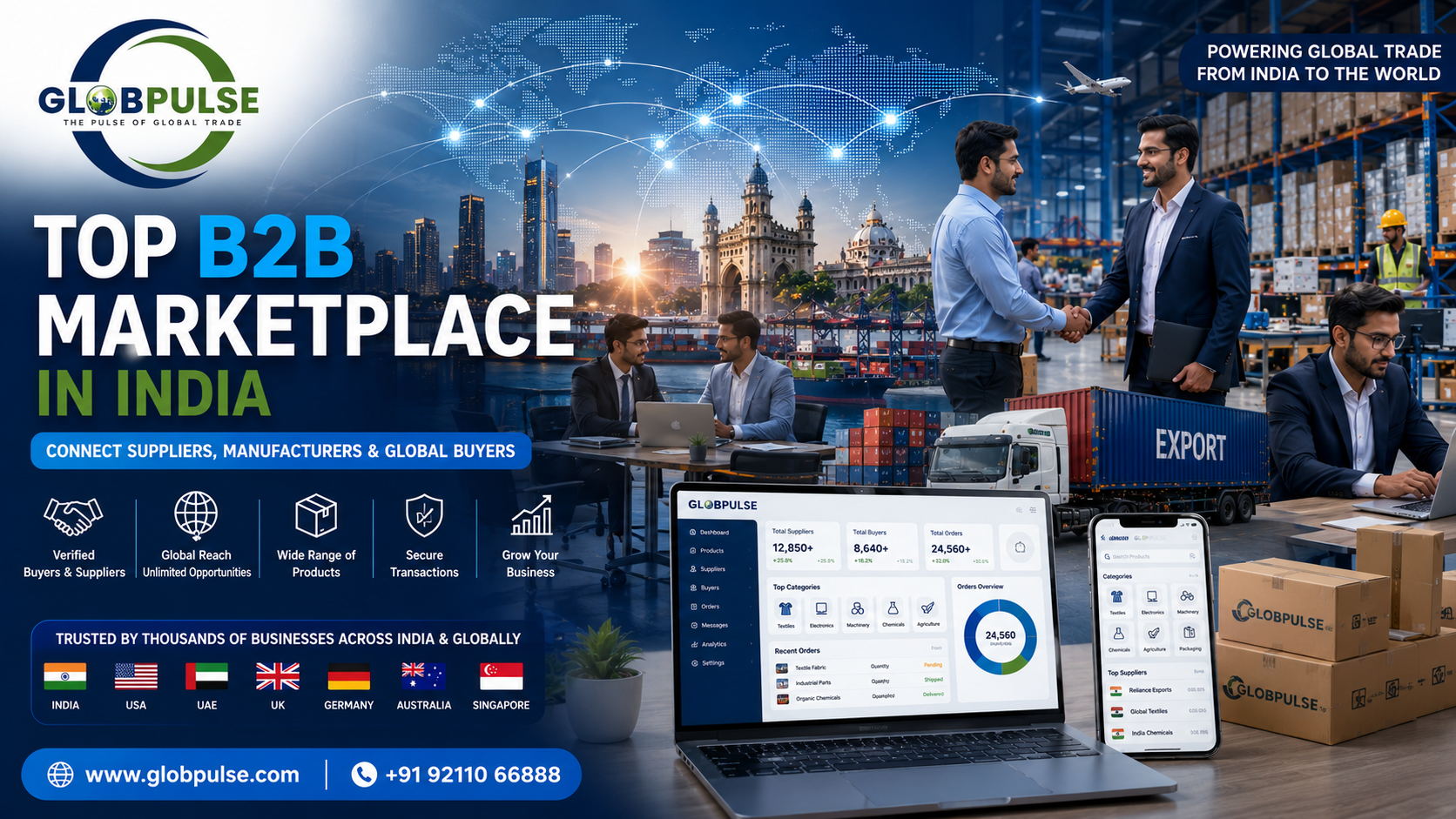
Best B2B Marketplace in India & Globally: The Complete 2026 Guide for Buyers and Sellers
If you've ever spent weeks chasing down reliable suppliers - only to hit dead ends, inflated prices, or unreliable shipping - you already understand why the right B2B marketplace changes everything.
Whether you're a manufacturer in Surat looking to reach international buyers, an importer sourcing raw materials at scale, or a procurement manager tired of cold calls and email chains, the way B2B trade works has fundamentally changed. And for Indian businesses especially, the opportunity has never been bigger.
This guide covers everything: what a B2B marketplace actually is (not the textbook version — the real one), how it works in practice, what separates world-class platforms from the rest, and why platforms like Globpulse are fast becoming the go-to B2B portal for serious Indian and global traders.
Let's get into it.
What Is a B2B Marketplace?
A B2B marketplace is a digital platform where businesses - manufacturers, suppliers, wholesalers, and exporters — connect to buy and sell products in bulk. Unlike B2C platforms (which sell to individual consumers), B2B marketplaces are built for high-volume, high-value trade between companies.
But here's what the textbook definition misses: a great B2B marketplace isn't just a directory. It's an active trade ecosystem — one where verified buyers meet verified sellers, where price discovery is transparent, and where the friction of traditional sourcing (middlemen, offline negotiations, long verification loops) is stripped out.
Think of it as the difference between a fax machine and a video call. Both "communicate," but the gap in speed, reach, and outcome is enormous.
In 2026, the global B2B ecommerce market is valued at over $36 trillion - nearly six times the size of B2C ecommerce. India alone is projected to account for a significant slice of this, driven by rising digital adoption in manufacturing hubs, growing export ambitions, and government-backed digitisation programs like Make in India and Digital India.
How Does a B2B Marketplace Work?
Understanding the mechanics helps you use these platforms strategically - not just passively.
Here's the typical flow on a modern online B2B marketplace:
1. Seller Onboarding & Verification
Manufacturers, suppliers, and exporters create business profiles. Reputable platforms — including Globpulse — verify business credentials: GST registration, export licenses, product certifications, and trade history. This step is non-negotiable for trust.
2. Product Listing & Cataloguing
Sellers upload detailed product catalogs with MOQs (minimum order quantities), pricing tiers, lead times, packaging specifications, and high-resolution images. Rich product data improves discoverability and buyer confidence.
3. Buyer Discovery & Sourcing
Buyers — whether they're wholesalers, distributors, or procurement managers — search using filters: product category, location, certifications, MOQ range, price bracket. Smart platforms serve personalised recommendations based on buying patterns.
4. RFQ (Request for Quotation)
Buyers submit RFQs directly to shortlisted suppliers. Suppliers respond with customised quotes. This replaces hours of cold outreach with a structured, time-bound process.
5. Negotiation & Deal Closure
Some platforms offer built-in messaging and negotiation tools. Deals close faster because context (product specs, pricing history, supplier ratings) is all in one place.
6. Trade Assurance & Logistics
Premium B2B portals provide trade assurance (escrow-based payment protection), documentation support (invoices, packing lists, certificates of origin), and logistics integrations.
Benefits of Using a B2B Marketplace — Real, Measurable Ones
Let's be direct. The benefits of B2B marketplaces aren't theoretical. They show up in margin, time, and scale.
For Buyers (Importers, Wholesalers, Retailers)
- Access to verified suppliers at scale — No more guessing who's legitimate. Vetted supplier directories reduce sourcing risk dramatically.
- Competitive pricing through transparency — When multiple suppliers compete for your business, prices come down. Buyers on established B2B trading platforms report saving 15–30% on procurement costs.
- Faster sourcing cycles — What used to take weeks of trade fair attendance and email threads can happen in 48–72 hours on a digital B2B platform.
- Global reach from a local desk — A textile buyer in Mumbai can source from a factory in Turkey or Vietnam without leaving their office.
- Reduced dependence on intermediaries — Direct manufacturer access cuts the middleman, improving both price and product accuracy.
For Sellers (Manufacturers, Exporters, Suppliers)
- Wider buyer reach, domestically and internationally — India's manufacturers have historically been constrained by geography and network size. A global B2B marketplace removes both barriers.
- 24/7 lead generation — A well-optimised product listing works around the clock, generating inquiries even when your sales team is offline.
- Brand credibility — Being listed on a trusted B2B portal signals legitimacy to international buyers who can't visit your factory.
- Data-driven insights — Analytics on who's viewing your listing, which products get the most RFQs, and where your buyers are located help you refine your offering.
- Lower customer acquisition cost — Compared to trade fairs, cold outreach, or advertising, the cost-per-lead on B2B platforms is significantly lower.
Top Features of a Modern B2B Marketplace
Not all B2B portals are equal. Here's what separates a genuinely useful platform from one that just looks good in a demo:
| Feature | Why It Matters |
|---|---|
| Verified seller profiles | Reduces fraud risk, builds buyer trust |
| Advanced search & filters | Faster, more precise sourcing |
| Multi-currency & multi-language support | Essential for cross-border trade |
| RFQ system | Streamlines quotation process |
| Trade assurance / escrow | Protects buyers and sellers in large transactions |
| Logistics integrations | End-to-end visibility on shipments |
| Mobile-optimised interface | Most B2B buyers in India now use mobile-first |
| SEO-optimised product pages | Helps sellers get discovered organically |
| Analytics dashboard | Empowers data-driven decisions |
| Rating & review system | Creates accountability and trust signals |
Platforms that combine all of the above — like Globpulse — are the ones where serious trade actually happens.
Why Indian Businesses Specifically Need B2B Platforms Right Now
India is at an inflection point. Here's the honest picture:
India exported goods worth over $776 billion in FY2023–24. The government's target for FY2030 is $2 trillion. That's an enormous ambition — and it cannot be achieved through trade fairs and cold calls alone.
The gap between India's manufacturing capacity and its global market penetration is still significant. A factory in Rajkot making precision auto components may be world-class in quality, but unknown to buyers in Germany or Canada. A spice exporter in Kerala may have the best product in the category, but lack the digital infrastructure to communicate that to buyers in the US or Middle East.
This is exactly where Indian B2B marketplaces and global B2B platforms solve a real problem — not an imagined one.
Key challenges Indian businesses face without a B2B portal:
- Overdependence on physical trade fairs (expensive, seasonal, geographically limited)
- Low digital visibility for international buyers searching online
- Lack of structured buyer-seller communication tools
- Difficulty showcasing certifications and compliance to global buyers
- Slow payment and documentation cycles
And these aren't small-business problems. Even mid-sized Indian exporters with strong offline networks are leaving significant revenue on the table by not maintaining a strong presence on B2B trade platform.
Best B2B Marketplace in India: What to Look For (And Where to List)
If you're evaluating platforms — as a buyer sourcing from India, or as an Indian supplier — here's what to compare:
Key Evaluation Criteria
1. Buyer Traffic Quality Raw traffic numbers are meaningless. What matters is whether the platform attracts genuine, purchase-intent buyers — not casual browsers. Look for platforms that publish verified buyer inquiry volumes and conversion benchmarks.
2. Seller Verification Standards How does the platform verify suppliers? GST verification alone isn't enough. Strong platforms check export history, product quality certifications (ISO, BIS, FSSAI, etc.), and business registration authenticity.
3. Industry Vertical Depth A general directory that lists everything from steel to spices to software often does justice to none. Look for platforms that have genuine depth in categories relevant to your business.
4. International Reach For Indian exporters, it's not enough to reach domestic buyers. The platform should actively connect Indian suppliers with buyers in the US, Europe, Middle East, Southeast Asia, and Africa.
5. Support Infrastructure Does the platform offer account managers, onboarding support, and dispute resolution? For high-value B2B transactions, this matters more than most buyers expect before their first problem.
How Globpulse Helps Manufacturers, Exporters & Suppliers Win More Business
Globpulse is built specifically for the way modern B2B trade actually works — not the way it worked in 2010.
Here's what makes Globpulse different for Indian businesses:
Verified Buyer-Seller Network
Every business on Globpulse is verified. For sellers, this means your profile stands out in a field of legitimate, vetted competitors — not anonymous listings. For buyers, it means the suppliers you find are real, responsive, and trade-ready.
India-Focused, Globally Connected
Globpulse is deeply rooted in Indian trade — understanding the categories, compliance requirements, and business culture that matter to Indian manufacturers and exporters. But its buyer network extends globally, connecting Indian suppliers with international buyers who are actively sourcing from India.
Category Depth That Actually Helps
Whether you're in textiles, chemicals, agricultural commodities, engineering goods, electronics, or FMCG — Globpulse has structured category trees with relevant specifications, certifications, and filters. This isn't a catch-all directory; it's a curated marketplace.
RFQ Engine Built for Serious Sourcing
Globpulse's RFQ system is designed for buyers who know what they want and need it quoted quickly. Sellers receive structured, high-intent inquiries — not vague messages that waste sales team time.
Trade Intelligence & Insights
Globpulse surfaces trade data and market intelligence that helps businesses make smarter sourcing and selling decisions — which categories are growing, where demand is shifting, and what pricing benchmarks look like across geographies.
List your business on Globpulse → and start reaching verified buyers today.
B2B Marketplace vs. Traditional Wholesale: An Honest Comparison
There's still a significant portion of B2B trade in India that happens offline — through agents, local distributors, and physical markets like APMC mandis, textile wholesale marketplace in Surat, and electronics markets in Nehru Place. Is the online model genuinely better?
Here's an honest side-by-side:
| Factor | Traditional Wholesale | Online B2B Marketplace |
|---|---|---|
| Buyer reach | Local / regional | National & international |
| Operating hours | Business hours only | 24/7 |
| Lead generation cost | High (trade fairs, agents) | Significantly lower |
| Speed to first inquiry | Days to weeks | Hours to days |
| Verification of counterparty | Relationship-based | Platform-verified |
| Price transparency | Opaque | Transparent, competitive |
| Documentation support | Manual, slow | Integrated, automated |
| Scalability | Limited by physical presence | Unlimited |
| Trust signals for new buyers | Low (no reviews, no history) | High (ratings, certifications, trade history) |
The verdict: Traditional wholesale relationships still have value — especially for repeat, high-trust transactions where personal relationships matter. But for new customer acquisition, market expansion, and international reach, online B2B marketplaces win comprehensively.
The smartest businesses aren't choosing one over the other. They're using their existing relationships offline while systematically building their digital presence on platforms like Globpulse.
Local Suppliers vs. Global B2B Marketplace: Which Is Right for You?
This is a question procurement managers and importers wrestle with constantly. Here's how to think about it:
When to Prioritise Local Suppliers
- When lead times and logistics costs are the primary constraints
- When products require frequent quality inspection visits
- When regulatory compliance demands local sourcing (e.g., government procurement rules)
- When transaction values are low enough that offshore sourcing doesn't justify the overhead
When a Global B2B Marketplace Wins
- When domestic supply is limited or expensive for your category
- When you need scale that local suppliers can't provide
- When product quality or technical specifications are only available offshore
- When cost arbitrage (especially India-to-global or China-to-India) is significant
For Indian exporters, global B2B marketplaces like Globpulse resolve a specific tension: they need to reach international buyers cost-effectively, without the overhead of a global sales team or trade fair circuit. A well-maintained profile on a trusted B2B portal does that — continuously, scalably, and at a fraction of the cost.
The Future of B2B Ecommerce in India: 2026 and Beyond
The next phase of B2B ecommerce in India won't just be bigger — it'll be fundamentally different in how it operates.
AI-Powered Matching and Discovery
The days of passive search are fading. Next-generation B2B platforms use AI to proactively match buyers with suppliers based on transaction history, sourcing patterns, and business profiles — before the buyer even searches. Globpulse is building in this direction.
Embedded Trade Finance
One of the largest friction points in B2B trade — especially for SMEs — is working capital. Platforms that integrate trade finance (invoice discounting, supply chain finance, export credit) directly into the transaction flow will dramatically accelerate deal velocity.
Real-Time Compliance and Documentation
Export documentation — shipping bills, certificates of origin, phytosanitary certificates, LC handling — has historically been a bottleneck. Platforms integrating with customs systems, banks, and freight forwarders will compress timelines from days to hours.
Sustainability and ESG Verification
International buyers — particularly from Europe — are increasingly requiring suppliers to demonstrate ESG compliance: carbon footprint reporting, fair labor certifications, sustainable sourcing documentation. B2B platforms that help Indian manufacturers surface these credentials will have a significant advantage.
Hyperlocal B2B Marketplaces
Beyond pan-India platforms, there's growing demand for region- and cluster-specific B2B portals — for Tiruppur's garment exporters, Morbi's ceramic manufacturers, Ludhiana's industrial goods producers. Platforms that serve these clusters with deep, relevant functionality will capture significant trade volumes.
Common Challenges on B2B Platforms — And How to Overcome Them
Let's not pretend this space is without friction. Here are the real challenges businesses face — and practical solutions:
Challenge 1: Low-Quality Inquiries
Problem: Many sellers report receiving inquiries from buyers who aren't serious, can't meet MOQs, or are just price-fishing. Solution: Optimise your profile with clear MOQ requirements, pricing tiers, and certification details. This self-selects for serious buyers. Platforms with verified buyer profiles (like Globpulse) also filter out noise at the source.
Challenge 2: Trust Deficit with New Counterparties
Problem: Especially for cross-border transactions, trust is the biggest barrier. Buyers are skeptical of suppliers they've never met; sellers are wary of new buyers who might not pay. Solution: Use platforms with trade assurance features. Build a strong review history by delivering consistently on smaller initial orders. Keep your profile fully updated with verifiable documents.
Challenge 3: Price Competition That Erodes Margins
Problem: When multiple suppliers are listed side by side, buyers default to lowest price. Solution: Compete on value, not just price. Certifications, faster lead times, flexible MOQs, better packaging, and strong post-sale support all justify premium pricing. Your profile should communicate these differentiators clearly.
Challenge 4: Inconsistent Lead Flow
Problem: Initial registrations get traffic; then inquiries dry up. Solution: Treat your B2B marketplace profile like a living asset. Update product listings seasonally. Add new certifications as you acquire them. Respond to all inquiries within 24 hours — platforms track and reward responsiveness.
Challenge 5: Logistics and Last-Mile Complexity
Problem: Particularly for export transactions, logistics coordination — freight forwarding, customs clearance, documentation — remains complex. Solution: Use platforms that integrate with logistics partners or have dedicated export support teams. Globpulse offers guidance on export logistics to help suppliers navigate this complexity.
Expert Tips to Grow Your Business on B2B Platforms
These are practical, field-tested strategies — not generic marketing advice:
1. Invest in your profile like it's your storefront. Blurry product photos, incomplete descriptions, and missing certifications cost you inquiries every day. Treat your B2B marketplace profile as seriously as your physical showroom.
2. Respond within 4 hours. In cross-border sourcing, buyers are often comparing multiple suppliers across time zones. The first supplier to respond with a coherent, professional quote wins disproportionately more deals than their quality might even justify.
3. Segment your catalog strategically. Don't list every product you've ever made. Lead with your highest-volume, highest-margin products. Quality of listing beats quantity every time.
4. Collect and display certifications prominently. ISO 9001, BIS mark, FSSAI, APEDA registration, Sedex/SMETA — these aren't bureaucratic footnotes. For international buyers, they're shorthand for "you can trust this supplier."
5. Ask for reviews after every successful transaction. Five authentic reviews on a verified platform are worth more than 500 marketing words about your quality and reliability.
6. Use analytics to refine, not just report. Which products get the most views but fewest inquiries? That's a gap between product appeal and listing quality. Which inquiries convert to orders? That tells you something about buyer quality segmentation. Use these signals actively.
7. Price for the relationship, not just the order. In B2B trade, first orders are rarely the point. The relationship — and the repeat volume — is. Structure your first-order pricing to incentivise commitment, not to maximise short-term margin.
Frequently Asked Questions (FAQ)
What is a B2B marketplace?
A B2B marketplace is a digital platform where businesses buy and sell products or services with each other — typically in bulk. It connects manufacturers, suppliers, wholesalers, and exporters with buyers like importers, distributors, and procurement teams. Unlike retail platforms, B2B marketplaces focus on high-volume, business-to-business transactions.
What is the best B2B marketplace in India?
Several platforms serve the Indian market — Globpulse, IndiaMart, TradeIndia, and ExportersIndia are among the known names. For businesses focused on verified trade connections, international reach, and category depth, Globpulse has emerged as a trusted choice for Indian manufacturers, exporters, and wholesale suppliers.
How is a B2B portal different from a B2C website?
A B2B portal (like Globpulse) is designed for business buyers purchasing in bulk — with features like RFQ systems, trade assurance, MOQ controls, and multi-tier pricing. A B2C website sells to individual consumers in single units. The buyer profile, transaction size, and relationship dynamics are fundamentally different.
Can small manufacturers benefit from a B2B marketplace?
Absolutely. In fact, B2B marketplaces level the playing field significantly for small and medium manufacturers. A small manufacturer in Rajasthan with excellent product quality now has the same channel access as a large corporation. The key is a well-optimised, verified profile that communicates quality and reliability effectively.
Is it safe to buy from suppliers on B2B platforms?
On platforms with strong verification standards, yes. Look for suppliers with verified business credentials, positive trade reviews, and certifications. Platforms like Globpulse have verification processes that screen suppliers before they can list products. For large transactions, use trade assurance or escrow payment options.
How do I find verified suppliers on a B2B marketplace?
Use platform filters to surface only verified suppliers. Look for badges that indicate business verification (GST-verified, export-licensed, ISO-certified). Check the supplier's trade review history. Prioritise suppliers who respond quickly and provide detailed product specifications without being asked.
What are the top product categories on Indian B2B marketplaces?
India's strongest B2B categories include: textiles and apparel, agricultural commodities and spices, chemicals and pharmaceuticals, engineering and auto components, electronics and electrical equipment, construction materials, gems and jewellery, and processed food products. Globpulse covers all of these with category-specific tools.
How much does it cost to list on a B2B marketplace?
Pricing varies by platform. Most offer a free basic listing with premium features (enhanced visibility, RFQ priority, analytics, trade assurance) available through paid plans. For serious exporters and suppliers targeting high-value buyers, the ROI on a paid plan typically justifies the cost significantly. Visit Globpulse for current plan details.
What is the difference between a wholesale B2B marketplace and an import-export marketplace?
A wholesale B2B marketplace primarily connects domestic buyers and sellers for bulk trade. An import-export marketplace specifically facilitates cross-border transactions — connecting exporters in one country with importers in another, with features for customs documentation, international logistics, and multi-currency pricing. Many platforms, including Globpulse, serve both functions.
How does Globpulse help Indian exporters?
Globpulse provides Indian manufacturers and exporters with verified international buyer access, an RFQ system designed for export inquiries, trade documentation support, and category-specific listing tools. It bridges the gap between India's manufacturing strength and global buyer demand — with a platform built for the operational realities of Indian export trade.
Conclusion: The Right B2B Marketplace Can Transform Your Trade Business
Here's what we know for certain: the businesses that will dominate B2B trade in 2026 and beyond are not the ones with the biggest factories or the lowest prices. They're the ones with the best digital infrastructure - the clearest presence on the right platforms, the fastest response times, and the most well-documented proof of quality.
India has everything it needs to be a global B2B trade powerhouse: manufacturing scale, supply chain depth, an enormous and growing domestic market, and competitive pricing across hundreds of product categories.
What it has historically lacked is the digital channel infrastructure to connect all of that to the buyers who need it.
That's changing — fast. And platforms like Globpulse are a meaningful part of how it's changing.
Whether you're a manufacturer in Gujarat looking to reach buyers in Europe, an importer in Mumbai sourcing from South Asia, or a procurement manager anywhere in the world looking for verified Indian suppliers — the platform you choose to trade on matters enormously.
Don't leave your trade growth to chance or to cold email chains.
Ready to Grow Your B2B Business?
Connect with verified buyers and suppliers across India and globally. List your business, post your sourcing requirements, or explore India's most trusted B2B marketplace for manufacturers, exporters, and wholesale suppliers.
Your next trade relationship is one search away.